


When Government PR Tries Too Hard: Why the DfE’s Social Media Strategy Risks Undermining Trust
There's a growing difference between communicating with the education profession and performing at it. Recently, the Department for Education’s communications strategy has increasingly drifted towards the latter. First came the widely criticised Gemma Collins interviews with the Secretary of State: a surreal attempt to blend celebrity culture with education policy messaging. Now we have the latest series of Millennial PR Team vs Gen Z Social Team social media graphics attempting to explain government education policy through emojis, internet slang and TikTok-style phrasing such as:
'Funded childcare SLAY.'
'It’s giving ✨thrifty✨.'
'Hassle free morning hallelujah.'
At best, they feel awkward. At worst, they trivialise serious policy issues affecting children, families and schools.
The problem here isn't that government departments should avoid social media or modern communication methods. Nor is it that humour can never have a place in public messaging. The issue is one of tone, judgement and credibility. Education is not a lifestyle brand. The Department for Education is responsible for some of the most significant public policy areas in the country: children’s safeguarding, teacher recruitment and retention, SEND provision, education standards, attendance, school funding and social mobility to name a few. Schools are navigating extraordinary levels of pressure, workload and scrutiny. Parents are struggling with childcare costs, attendance concerns and access to support services. Teachers and leaders are exhausted by change, policy churn, rising expectations and diminishing resource .
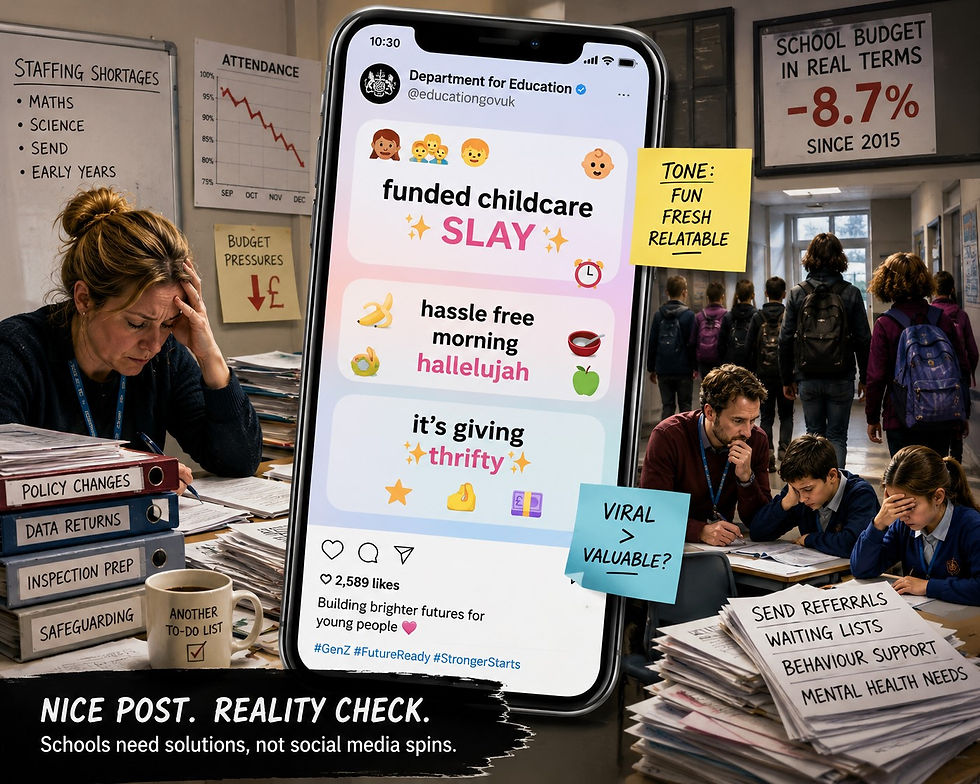
Against this backdrop, communications that appear to parody internet culture can feel deeply disconnected from the reality of the profession. There's also a wider issue around trust. The relationship between the DfE and the education sector has, at times, become strained. Many school leaders feel policy is too often done to them rather than developed with them. Trust is built through consistency, clarity, credibility and professional respect. Yet more recently, government communications appear designed around engagement metrics rather than meaningful engagement itself. Views. Shares. Reactions. Virality. Public sector communications shouldn't simply chase attention. They should build confidence. And this is where the strategy appears flawed.
Good PR isn't about trying to sound younger, trendier or more online than your audience. In fact, audiences are usually highly sensitive to inauthenticity. Gen Z does not suddenly trust a government department because it uses emojis and TikTok phrasing. If anything, forced attempts to imitate internet culture often achieve the opposite effect: they feel corporate, calculated and artificial. The irony is that many of the underlying policies being promoted are actually significant and worthy of serious discussion. Breakfast clubs matter. Childcare reform matters. Reducing school uniform costs matters. These are important policy areas with potentially meaningful implications for families. But instead of elevating the discussion, the messaging risks reducing it to meme-format communication that oversimplifies complex issues and weakens the seriousness of the message.
There is another danger too: credibility erosion. Government departments occupy a particular position in public life. Their communications should project competence, authority and reassurance. This doesn't mean being robotic or inaccessible. But there is a balance between being relatable and becoming performative. The DfE’s recent output increasingly feels like it is being developed by communications teams benchmarking themselves against commercial brand accounts rather than considering the expectations people have of public institutions. And schools notice. Teachers and leaders are highly attuned to tone. They spend their working lives communicating carefully with parents, pupils and communities. They understand the importance of audience, professionalism and trust. Many will look at these campaigns and question whether the department truly understands how the profession currently feels.
At a time when education faces major challenges around recruitment, retention, SEND capacity, attendance, funding pressures and wellbeing, the profession does not need gimmicks. It needs confidence that government understands the seriousness of the issues schools are grappling with every day. The DfE doesn't need to become dull. But it does need to become more credible. Effective public communication is not about sounding viral. It's about being trusted.


Comments