


There's No Such Thing as a 'Typical' Student: Why Apprenticeship Education is Distinctive
Challenging our assumptions
One of the biggest misconceptions in higher education is that there's such a thing as a 'typical' university student. For many, the image still conjures up an 18-year-old leaving home for the first time, living in student accommodation and studying full-time. Whilst that remains the reality for some, it no longer reflects the diversity of today's student population.
Today's learners come from an extraordinary range of backgrounds and life experiences. Some enter higher education directly from school or college, whilst others return after many years away from formal education. Many combine study with employment. Others balance learning alongside caring responsibilities, family life or other personal commitments. Some study full-time, others part-time. Increasingly, universities are communities of learners whose routes into higher education are as diverse as their aspirations.
Perhaps, then, the more interesting question isn't whether apprentices are different from other university students. Instead, we should ask what makes apprenticeship education distinctive. The answer lies not in who apprentices are, but in how they learn.
An educational model built around integration
Apprenticeships are intentionally designed around the integration of academic learning and professional practice. The workplace isn't simply somewhere an apprentice happens to spend time between university sessions. It's an integral part of the curriculum. Knowledge gained through academic study is continually tested, refined and applied within authentic professional contexts, whilst workplace experiences enrich learning back at the university.
Rather than viewing work and study as separate activities, apprenticeships deliberately connect them. This integration sits at the heart of the apprenticeship model and distinguishes it from many other forms of higher education. Ofsted refer to this model as purposeful integration. In order for it to be purposeful, it has to be deliberate.
Learning happens in multiple places
One of the most distinctive aspects of apprenticeship education is that learning takes place across multiple environments:
It happens in lectures and seminars.
It happens through workplace coaching and mentoring.
It happens whilst solving real problems with colleagues.
It happens through professional conversations, reflection and feedback.
Learning isn't confined to one location or one relationship. Instead, apprentices continually move between academic and professional contexts, making connections between theory and practice.
An apprentice studying leadership may explore different leadership models during a university session before reflecting on how those ideas apply within their own organisation. A nursing apprentice may immediately connect theoretical learning with clinical practice. A teacher apprentice may trial new pedagogical approaches before evaluating their impact. An engineering apprentice may apply technical principles to live projects.
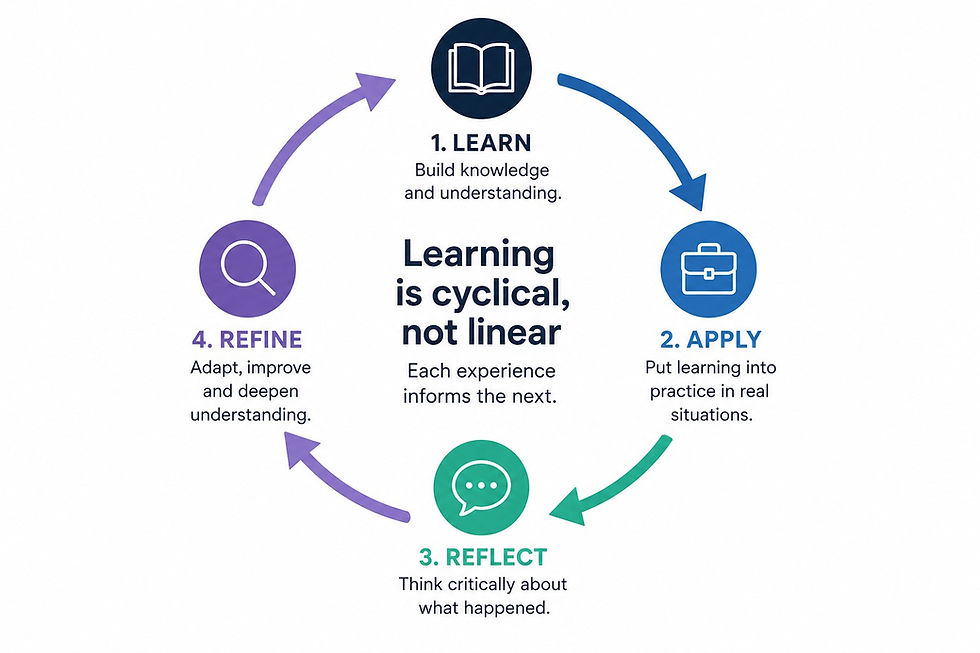
Learning becomes cyclical rather than linear, with each experience informing the next.
Success is broader than academic achievement
Academic achievement remains an important part of apprenticeship education. However, apprenticeships are designed to develop more than academic knowledge alone. Alongside achieving an academic qualification, apprentices are developing occupational competence, professional judgement, confidence and the knowledge, skills and behaviours required within their chosen profession.
Success is therefore measured not only by what learners know, but also by how effectively they can apply that knowledge in increasingly complex professional situations.
The importance of partnership
Another defining characteristic of apprenticeship education is the partnership between the apprentice, the university and the employer. Each has a distinct contribution to make:
Universities provide academic expertise, challenge and support.
Employers create opportunities for apprentices to apply learning within authentic workplace contexts and to develop professionally.
Apprentices themselves bring these experiences together through reflection, curiosity and a willingness to learn.
When these relationships are strong, learning becomes richer because knowledge, skills and behaviours are reinforced through experience and professional dialogue. When the partnership is weak, opportunities for learning can be lost or not maximised to their full potential.
Why this matters
Recognising the distinctive nature of apprenticeship education has important implications for universities and employers alike. Delivering apprenticeships isn't simply about adapting an existing degree programme. It requires curriculum design that deliberately connects academic learning with workplace application. It requires meaningful collaboration with employers, effective coaching and mentoring, carefully planned opportunities for professional development and robust quality assurance across both the academic and workplace environments.
This is why apprenticeship provision cannot be viewed simply as another mode of higher education delivery. It represents a distinctive educational model with its own pedagogy, partnerships and quality considerations.
A lesson for higher education
Perhaps apprenticeships also offer a wider lesson for higher education. Not because apprentices are fundamentally different from other students, but because they remind us that meaningful learning rarely happens in isolation.
The most powerful learning occurs when knowledge is explored, questioned, applied, reflected upon and refined through experience. For many students, those experiences may come through placements, volunteering, research, employment or wider life experiences. Apprenticeships provide a particularly structured and intentional model for bringing academic learning and professional practice together, but the underlying principle has much wider relevance.
Ultimately, what makes apprenticeship education distinctive is not the age, background or circumstances of those who undertake it. It's the deliberate integration of higher education with professional practice, creating an educational experience where learning is continually shaped by the interaction between knowledge, experience and application.
As higher education continues to evolve, perhaps the real challenge is not to ask whether apprentices are different, but to recognise that there is no such thing as a typical student. Every learner arrives with different experiences, responsibilities and ambitions. The role of universities is to create educational experiences that enable all students to connect what they learn with the lives they lead and the professions they aspire to join.


Comments